
New York Whistleblower Guide: False Claims Act Rewards, Retaliation Protections, and How to Report Fraud
New York has a long and storied history of holding corporations and individuals accountable for their actions. From Wall Street to the healthcare industry, whistleblowers play a critical role in exposing fraud, corruption, and misconduct that harms taxpayers and the public. If you have witnessed wrongdoing in your workplace, you may have the power to bring it to light and be rewarded for your courage. This comprehensive guide will walk you through the process of whistleblowing in New York, including the key whistleblower laws, incentives, and protections, the types of fraud you can report, and how an experienced New York whistleblower attorney can help you navigate this complex process.
This guide is written by experienced New York whistleblower attorneys at Pelton Graham LLP, a law firm that represents whistleblowers in False Claims Act and retaliation cases throughout New York City and statewide. If you are considering reporting fraud against the government or have suffered retaliation for speaking up, this guide explains your rights, potential rewards, and next steps.
New York Courthouse
What is Whistleblowing in New York?
Whistleblowing is the act of reporting information that you reasonably believe is evidence of a violation of law, rule, or regulation, or that poses a substantial and specific danger to public health or safety. In New York, whistleblowers are protected by a robust set of laws that not only shield them from retaliation but also provide financial incentives for reporting certain types of fraud against the government.
New York recognizes that employees, contractors, and other individuals often have access to information about wrongdoing that is not available to the public or government agencies. By protecting whistleblowers and rewarding them for coming forward, New York encourages the reporting of fraud and misconduct that would otherwise go undetected.
Whistleblowing laws in New York apply to employees, former employees, contractors, and in some cases independent contractors, and cover both public and private sector misconduct. An experienced New York whistleblower lawyer can help determine which laws apply to your situation and how best to proceed.
Types of Fraud and Misconduct You Can Report
Whistleblowers in New York can report a wide range of fraud and misconduct, including:
- Healthcare Fraud represents the largest category of whistleblower cases. This includes Medicare and Medicaid fraud, such as billing for services not rendered, upcoding (billing for more expensive services than were actually provided), kickbacks to physicians or other referral sources, and unnecessary medical procedures. The recent $556 million settlement with Kaiser Permanente, a federal and state False Claims Act case, demonstrates the scale of potential recoveries in healthcare fraud cases.
- Financial Fraud includes securities fraud, banking fraud, insurance fraud, and mortgage fraud. This category has historically been a major focus of whistleblower enforcement, particularly following the 2008 financial crisis.
- Government Contractor Fraud involves overbilling the government for goods or services, providing substandard or defective products, violating the terms of a government contract, or misrepresenting the nature of work performed. This includes fraud in defense contracting, infrastructure projects, and other government procurement. For more information, see our page on government contractor fraud.
- Government contractor fraud cases are a major focus of New York False Claims Act enforcement, particularly in construction, infrastructure, transportation, and public works projects throughout New York City and New York State.
- Tax Fraud involves underreporting income, illegally avoiding state or federal taxes, or claiming fraudulent deductions. The IRS and New York State Department of Taxation and Finance both have whistleblower programs that reward individuals for reporting tax fraud.
- Pharmaceutical and Medical Device Fraud includes off-label marketing (promoting drugs or devices for unapproved uses), paying kickbacks to physicians, and misrepresenting the safety or efficacy of products.
- Environmental and Safety Violations include violations of environmental regulations, workplace safety violations, and violations of occupational health and safety standards.
The New York False Claims Act: Your Key to Fighting Fraud
The New York False Claims Act is one of the most powerful tools available to whistleblowers in New York. Modeled after the federal False Claims Act, the New York version allows private citizens to file lawsuits on behalf of the state against individuals or companies that have defrauded the government. These lawsuits are known as qui tam actions, derived from the Latin phrase “qui tam pro domino rege quam pro se ipso in hac parte sequitur,” which means “who sues on behalf of the king as well as for himself.”
Whistleblower Rewards Under New York Law
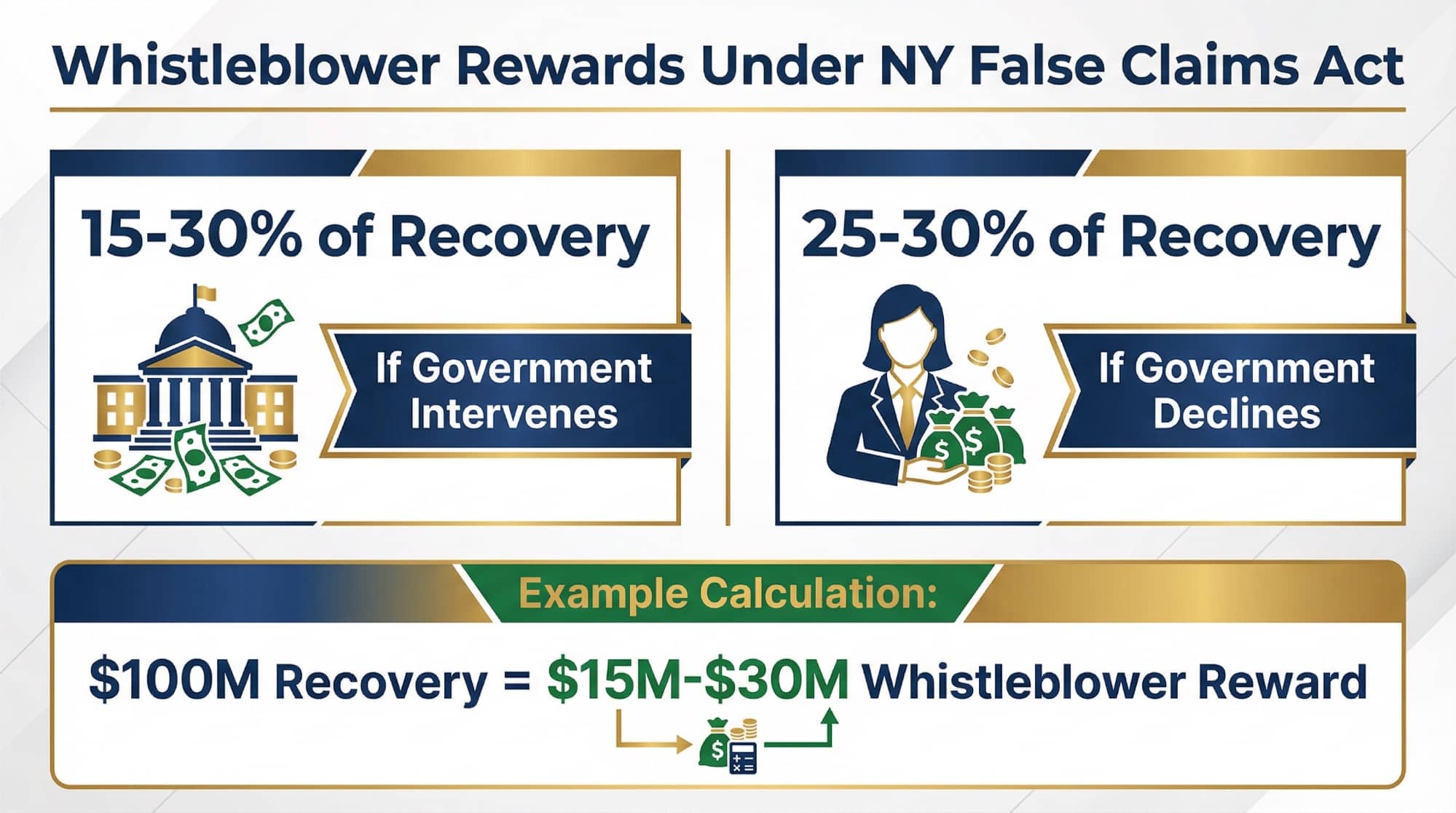
Under the New York False Claims Act, a whistleblower who files a successful qui tam lawsuit is entitled to a share of the recovery. The reward structure is as follows:
Whistleblower Rewards Infographic
With potential damages in the millions or even billions of dollars, successful whistleblower cases can result in substantial rewards, depending on the strength of the evidence, the whistleblower’s role, and whether the government intervenes. For example, in the recent Kaiser Permanente case, which resulted in a $556 million settlement, whistleblowers involved in the case were awarded $95 million.
Damages and Penalties
In addition to the actual damages (the amount of money the government lost due to the fraud), the False Claims Act provides for treble damages (three times the actual damages) and civil penalties. This means that if a company defrauded the government of $1 million, it could be liable for $3 million in damages plus civil penalties per false claim, which are adjusted periodically for inflation and can be substantial, in addition to treble damages.
Expanded Protections Under New York Labor Law § 740
In addition to the False Claims Act, New York provides some of the strongest whistleblower protections in the country through New York Labor Law § 740. In 2022, the law was significantly expanded to provide even greater protections for employees who report wrongdoing.
Retaliation Protections Infographic
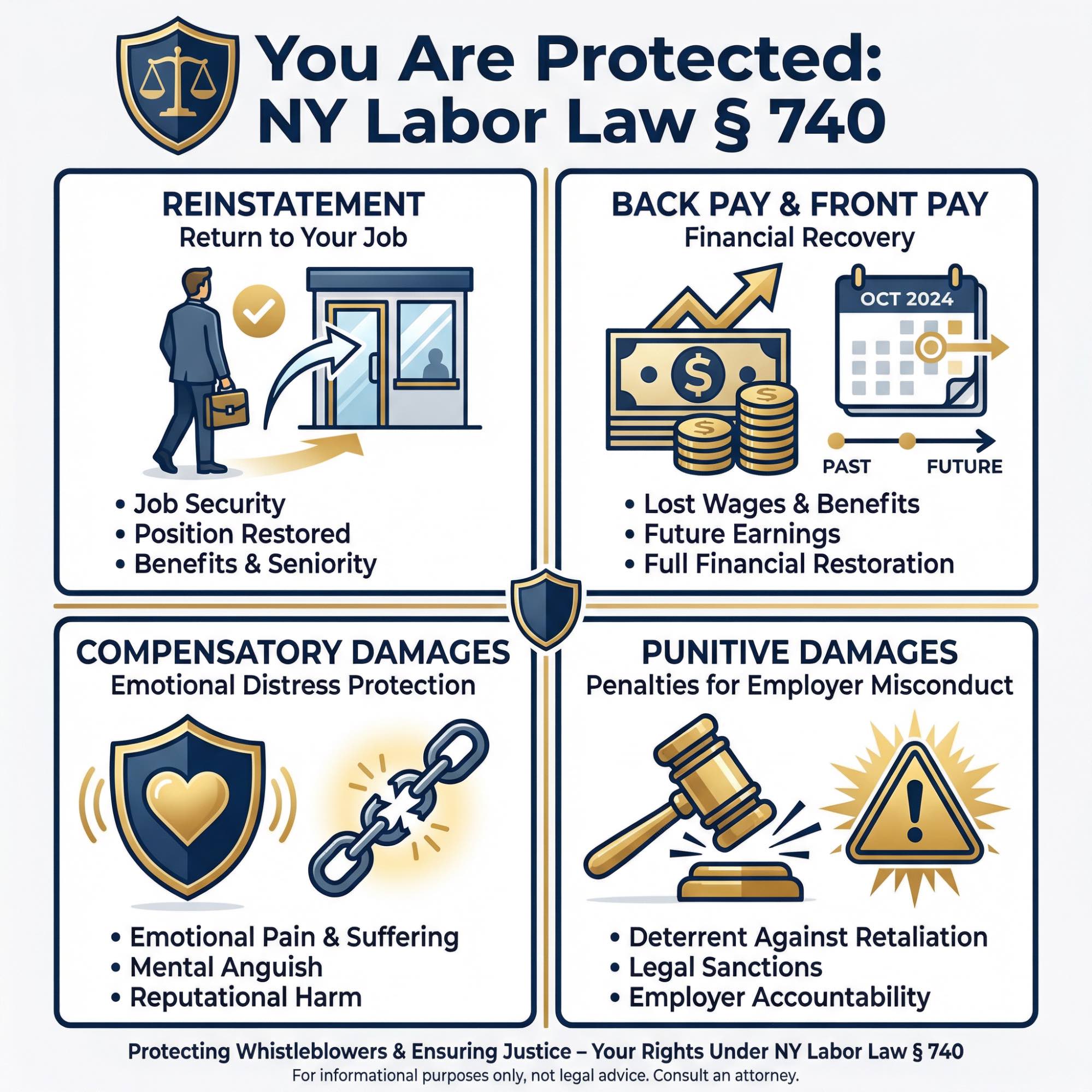
Fear of retaliation prevents many employees from reporting fraud and misconduct. New York Labor Law § 740 provides some of the strongest whistleblower protections in the nation. If you suffer retaliation for reporting wrongdoing, the law provides powerful remedies to make you whole and punish employers who violate your rights.
Reinstatement: Return to Your Job
If your employer terminates your employment in retaliation for whistleblowing, you have the right to reinstatement to your former position with the same responsibilities, seniority, and benefits. The court can order your employer to restore your position as if the retaliatory termination never happened, ensuring you do not suffer long-term career damage for doing the right thing.
Back Pay and Front Pay: Financial Recovery
Back pay covers all wages, bonuses, and benefits you lost from the time of the retaliatory action until your case is resolved. This includes base salary, overtime, commissions, bonuses, health insurance, retirement contributions, and other compensation.
Front pay compensates you for future lost earnings if reinstatement is not feasible. If the working relationship has become too damaged to return, the court may award front pay to compensate you for income lost until you find comparable employment elsewhere.
Compensatory Damages: Emotional Distress Protection
Retaliation causes more than financial harm. Being fired, demoted, or harassed for reporting wrongdoing takes a serious emotional toll. Compensatory damages cover emotional pain and suffering, mental anguish, damage to your professional reputation, and psychological impact. These damages acknowledge that your harm extends beyond lost wages and compensate you for the full extent of your injuries.
Punitive Damages: Penalties for Employer Misconduct
When your employer’s retaliatory conduct was particularly egregious, malicious, or intentional, New York law authorizes punitive damages in appropriate cases, particularly where the employer’s retaliatory conduct is willful, malicious, or egregious. These are designed to punish the wrongdoer and deter similar conduct in the future. Punitive damages send a clear message that retaliation against whistleblowers will not be tolerated and can significantly exceed compensatory damages in appropriate cases.
Additional Protections: Attorney’s Fees and Costs
If you prevail in a whistleblower retaliation case, you are entitled to recover your attorney’s fees and costs. This ensures you can pursue your legal rights even without the financial resources to pay for an attorney upfront, leveling the playing field against well-funded corporate defendants.
Key Features of the Expanded Law
Broader Definition of Protected Activity: The law now protects employees who report any activity they reasonably believe to be a violation of any local, state, or federal law, rule, or regulation. This is much broader than the previous version, which was limited to specific types of violations.
Protection for Former Employees: The law now explicitly protects former employees from retaliation. This is important because employers cannot punish you for whistleblowing by refusing to rehire you or by giving you a negative reference.
Expanded Definition of Retaliation: Retaliation is not just limited to termination or demotion. It can also include threats, harassment, unfavorable evaluations, reassignment, reduction in hours, or any other adverse action that could dissuade a reasonable employee from reporting wrongdoing.
Burden of Proof: In many cases, if an employee reports wrongdoing and then suffers an adverse employment action shortly thereafter, New York Labor Law § 740 creates a rebuttable presumption of retaliation, shifting the burden to the employer to demonstrate a legitimate, non-retaliatory reason for its actions. The employer must then prove that the adverse action was taken for a legitimate, non-retaliatory reason.
Whistleblower Retaliation: Know Your Rights
Fear of retaliation is one of the biggest concerns for potential whistleblowers. It is important to know that both federal and New York state laws provide strong protections against retaliation. If your employer takes any adverse action against you for reporting wrongdoing, you may be entitled to remedies such as reinstatement, back pay, and damages. If you believe you have been the victim of whistleblower retaliation, it is crucial to contact an experienced whistleblower retaliation lawyer as soon as possible. There are strict deadlines for filing retaliation claims, so it is important to act quickly to protect your rights.
Whistleblower Retaliation Lawyer in New York: Why Timing Matters
Retaliation claims under New York Labor Law § 740 are subject to strict filing deadlines, and delays can jeopardize your rights. Speaking with a New York whistleblower retaliation lawyer as early as possible can help preserve evidence, protect your job, and maximize your recovery.
Steps to Take if You are Considering Blowing the Whistle
If you have witnessed fraud or misconduct in your workplace, here are the steps you should take:
The Whistleblower Process: Four Steps to Fighting Fraud
If you have witnessed fraud or misconduct in your workplace, taking action can feel overwhelming. However, the whistleblower process is straightforward when you work with an experienced attorney. Here are the four essential steps to successfully reporting fraud and protecting your rights under the New York False Claims Act.
Step 1: Gather Evidence
The foundation of any successful whistleblower case is solid, credible evidence. Before approaching an attorney or filing a claim, you should carefully and legally gather documentation that supports your allegations. This evidence might include emails discussing fraudulent schemes, invoices showing false billing, spreadsheets revealing financial irregularities, internal memos, or your own detailed notes – including timestamps – documenting what you have witnessed.
It is critical to gather this evidence in a way that does not violate company policies or expose you to legal liability. Do not take company property without authorization, access systems you are not permitted to use, or alert your employer to your intentions. FFocus on documents you have legitimate access to through your normal work duties. The quality and credibility of your evidence will significantly impact the government’s decision to pursue your case.
You should never remove documents you are not authorized to access or violate confidentiality or data-security laws. A whistleblower attorney can advise you on how to preserve evidence lawfully and safely.
Step 2: Consult with an Experienced Whistleblower Attorney
Before you report any wrongdoing—whether internally to your company or externally to the government—it is essential to consult with an experienced New York whistleblower attorney who specializes in False Claims Act and retaliation cases. This consultation is confidential and will help you understand your rights, evaluate the strength of your case, and develop a strategic plan for moving forward.
An experienced whistleblower attorney will review your evidence, assess whether it meets the legal requirements for a qui tam lawsuit, advise you on the best approach for reporting the fraud, and help you understand the potential rewards and risks. Your attorney will also take steps to protect you from retaliation and ensure that you comply with all procedural requirements under the New York False Claims Act. This initial consultation is typically free, and most whistleblower attorneys work on a contingency basis, meaning you pay no fees unless your case is successful.
Step 3: File a Qui Tam Lawsuit
If you are reporting fraud against the government, your attorney will prepare and file a qui tam lawsuit on your behalf under the New York False Claims Act. This lawsuit is filed “under seal,” which means it remains confidential and is not disclosed to the defendant or the public. Filing under seal gives the government time to investigate your allegations without alerting the wrongdoer, which helps preserve evidence and prevent obstruction.
Your attorney will prepare a detailed complaint that outlines the fraudulent conduct, identifies the laws that were violated, calculates the damages to the government, and explains why you are entitled to bring this action. Along with the complaint, your attorney will file a disclosure statement that provides the government with all material evidence and information in your possession. This sealed filing initiates the formal legal process and triggers the government’s investigation.
Step 4: Cooperate with the Government Investigation
Once your lawsuit is filed, the New York Attorney General’s office (or other relevant government agency) will conduct a thorough investigation of your allegations. During this investigation, which typically lasts several months but can be extended, you should cooperate fully with government investigators and attorneys.
Cooperation means providing additional documents or information as requested, answering questions truthfully and completely, participating in interviews and depositions, and maintaining the confidentiality of the investigation. Your level of cooperation can significantly impact the government’s decision about whether to intervene in your case. If the government decides to intervene, it will take over the prosecution of the case, which greatly increases your chances of success. If the government declines to intervene, you still have the right to pursue the case on your own, though this path is more challenging.
Throughout this process, your attorney will guide you, protect your interests, and work to maximize your potential reward while minimizing your risk of retaliation.
How a New York Whistleblower Attorney Can Help
Navigating the complex world of whistleblower law can be challenging. An experienced New York whistleblower attorney can provide invaluable assistance by:
- Evaluating Your Case: An attorney can help you determine whether you have a valid whistleblower claim, what your chances of success are, and how to prepare to win.
- Protecting You from Retaliation: An attorney can help you understand your rights and take action to protect you from retaliation.
- Maximizing Your Reward: An attorney can help you structure your case in a way that maximizes your potential reward under the New York False Claims Act.
- Representing You in Court: If your case goes to trial, an attorney will represent you in court and fight for your rights.
Recent Whistleblower Successes in New York
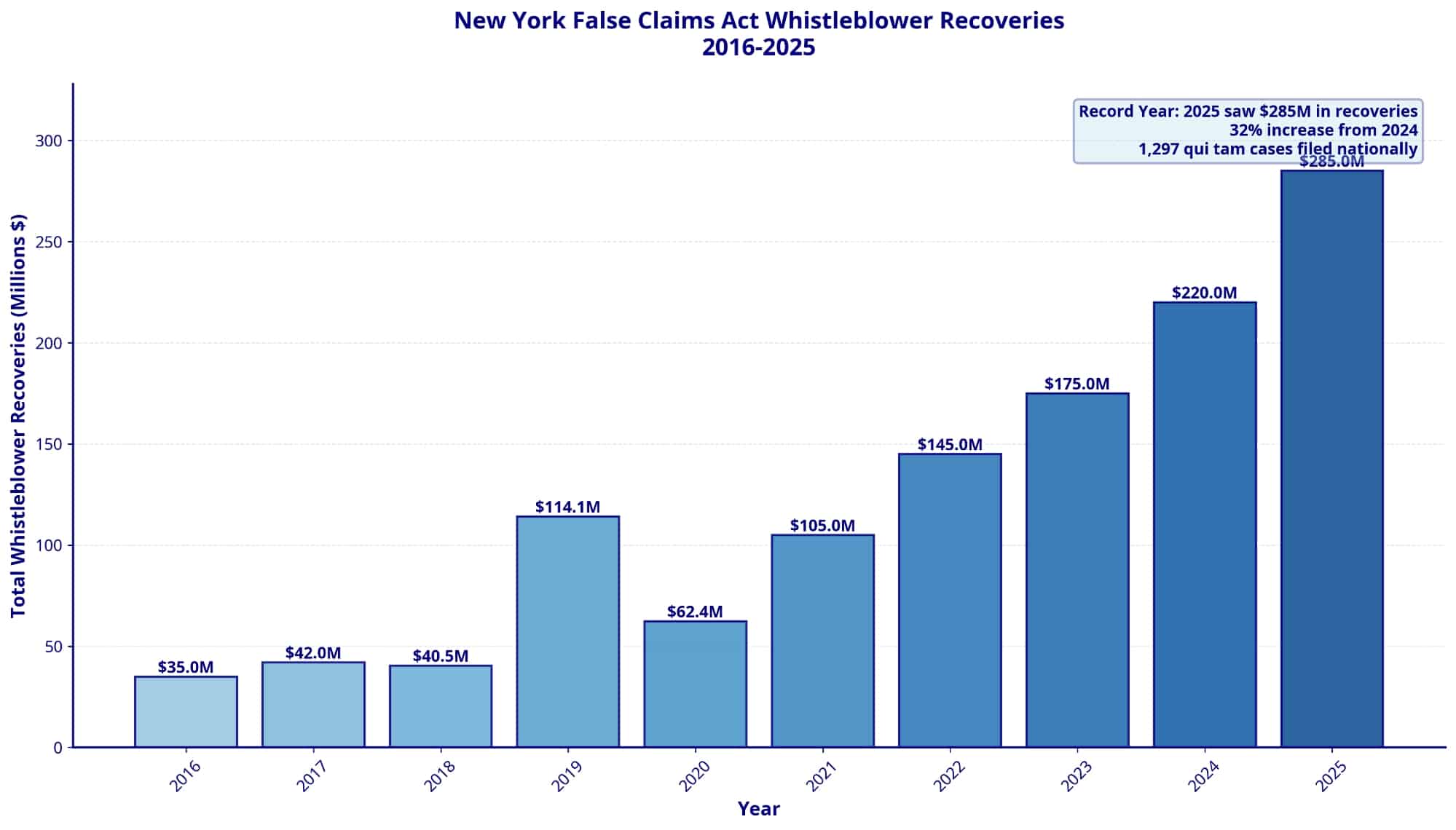
New York has a strong track record of successful whistleblower cases. Recent settlements and recoveries demonstrate the power of whistleblower actions to hold wrongdoers accountable and recover millions of dollars for the government. The U.S. Department of Justice reported that in fiscal year 2025, whistleblowers filed a record 1,297 qui tam lawsuits, resulting in over $6.8 billion in recoveries. A significant portion of these cases involved New York-based companies and New York government funds. Many of these recoveries involved New York-based companies, New York government funds, and whistleblowers represented by experienced qui tam counsel.
NY Whistleblower Recoveries Chart
Take the Next Step
If you have witnessed fraud, corruption, or other wrongdoing in your workplace, speaking with a whistleblower attorney before taking action can be critical. By coming forward, you can help protect taxpayers, hold wrongdoers accountable, and be rewarded for your courage. The team at Pelton Graham is here to help you every step of the way.
Our experienced whistleblower attorneys have successfully represented clients in a wide range of cases, from healthcare fraud to government contractor fraud. We understand the challenges and risks involved in blowing the whistle, and we are committed to protecting your rights and maximizing your reward.
You may have a whistleblower case if you have seen:
- False billing to Medicaid, Medicare, or New York government agencies
- Government contractors overbilling or performing substandard work
- Kickbacks, upcoding, or phantom services
- Retaliation after reporting or questioning misconduct
A confidential consultation with a New York whistleblower lawyer can help you understand your options.
Contact us today for a confidential consultation. We offer free initial consultations to discuss your potential whistleblower case. There is no obligation, and your consultation will be completely confidential.
Additional Resources
For more information about whistleblower protections and how to report fraud, you may find the following resources helpful:
- U.S. Department of Justice – Whistleblower Program: Information about the federal False Claims Act and qui tam lawsuits.
- New York State Attorney General – False Claims Unit: Information about the New York False Claims Act and how to report fraud against the state.
- New York State Department of Labor – Whistleblower Protections: Information about whistleblower protections under New York Labor Law § 740.
- National Whistleblower Center: A nonprofit organization dedicated to protecting whistleblowers and promoting whistleblower-friendly policies.
- Government Accountability Project: Resources and advocacy for whistleblowers in the public and private sectors.
References
[1] New York State Office of the Attorney General. (2022). The New York False Claims Act. Retrieved from https://ag.ny.gov/sites/default/files/2022-08/nyfca.pdf
[2] New York State Department of Labor. (2022). Notice of Employee Rights, Protections, and Obligations Under Labor Law Section 740. Retrieved from https://dol.ny.gov/system/files/documents/2022/02/ls740_1.pdf
[3] U.S. Department of Justice. (2026, January 17). False Claims Act Settlements and Judgments Exceed $6.8 Billion in Fiscal Year 2025. Retrieved from https://www.justice.gov/opa/pr/false-claims-act-settlements-and-judgments-exceed-68b-fiscal-year-2025
[4] National Whistleblower Center. (2025). Whistleblower Resources and Advocacy. Retrieved from https://whistleblowers.org/
[5[5] Government Accountability Project. (2025). Whistleblower Support and Resources. Retrieved from https://whistleblower.org/
This guide is for informational purposes only and does not constitute legal advice. Reading this guide does not create an attorney-client relationship.